The LC1D18 is an electromagnetic switching device used to control appropriately rated AC power circuits through a separate control circuit.
Its three main contacts provide the switching function, while the built-in 1NO and 1NC auxiliary contacts support control and indication functions.
The auxiliary contacts must not be treated as additional main power poles or assumed to have the same current rating.
When incorporated into a motor starter, the contactor must be coordinated with suitable overload and short-circuit protective devices.
Technical Specifications
The YQNT LC1D18 features three main power contacts and two auxiliary contacts, identified by the terminal markings on the product.
| Terminal Pair | Function |
| 1/L1 – 2/T1 | Main power contact, pole 1 |
| 3/L2 – 4/T2 | Main power contact, pole 2 |
| 5/L3 – 6/T3 | Main power contact, pole 3 |
| 13 – 14 | Normally open auxiliary contact |
| 21 – 22 | Normally closed auxiliary contact |
| A1 – A2 | Electromagnetic control-coil terminals |
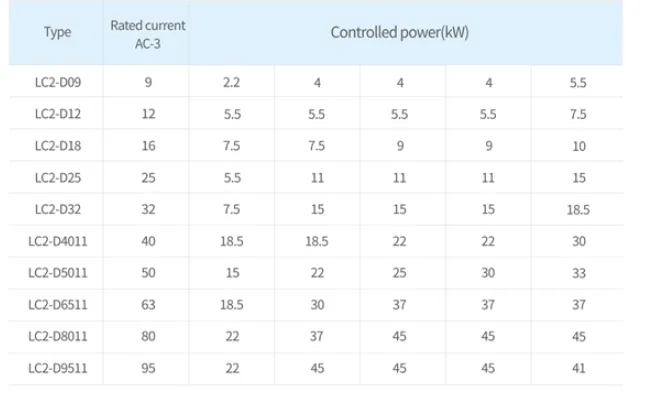
The approved model-specific datasheet should be used to verify the final AC-3 rating, control-coil voltage, motor power, insulation ratings, installation requirements, and electrical endurance.
Product Applications
The YQNT LC1D18 can be considered for industrial AC motor-control applications where its electrical ratings, switching duty, coil configuration, and protective-device coordination meet the operating requirements.
Three-Phase Motor Starter Panels
The LC1D18 can be incorporated into direct-on-line (DOL) motor starter panels to switch appropriately rated three-phase AC motors.
Its three main contacts perform the motor switching function, while the auxiliary contacts may support control logic or status indication.
Selection requires checking the motor's nameplate current, supply voltage, AC-3 operational rating, and starting conditions. Suitable overload and short-circuit protection must also be provided.
Pump and Water-Control Systems
The LC1D18 may be considered for pump-control panels used in water supply, pressure control, and liquid-level management.
A pressure switch, float switch, or control relay can issue switching commands through an appropriately designed coil-control circuit.
The contactor should be selected according to the pump motor's current, operating voltage, starting conditions, and switching frequency. Separate protection may be required for overload, phase failure, or dry-running conditions.
HVAC and Ventilation Equipment
In HVAC and ventilation systems, the LC1D18 may be used to switch suitably rated fan motors through compatible control equipment.
Its auxiliary contacts can support appropriately rated control and indication functions within the equipment control circuit.
Before selection, verify the fan motor's rated current, power supply, starting characteristics, expected operating frequency, and protective-device requirements.
Conveyors and OEM Industrial Machinery
The LC1D18 can be incorporated into motor-control panels for conveyors, packaging equipment, and other industrial machinery where controlled AC motor switching is required.
Its 1NO and 1NC auxiliary contacts may be used in suitably designed signalling or interlocking circuits.
Applications involving frequent inching, plugging, or reversing require additional evaluation of the utilization category and switching duty. AC-3 ratings must not automatically be applied to AC-4 operating conditions.
Detailed Photos
Control Coil and Ordering Options
The LC1D18 features electromagnetic control-coil terminals identified as A1 and A2.
The control-coil voltage must be selected according to the actual control supply and the available product configuration.
The coil voltage (Uc) and main-circuit operating voltage (Ue) are separate electrical parameters and must be checked independently.
For PLC-controlled equipment, verify the coil's operating current and the output module's switching capacity. An interface relay or appropriate suppression device may be required.
Motor Selection and Protection
The LC1D18 provides an electromagnetic switching function. It does not independently provide complete motor overload or short-circuit protection.
For motor-control applications, the contactor should be coordinated with appropriately selected protective devices.
Before ordering, verify the motor's nameplate current, supply voltage, utilization category, starting method, and switching frequency.
Dimensions and Installation
Use the approved YQNT LC1D18 dimensional drawing before finalizing control-panel layout or replacement installation.
Check the required mounting method, wiring clearances, conductor sizes, tightening torque, and environmental operating conditions.
Dimensions and installation specifications from other manufacturers should not be treated as proof of direct interchangeability.
Technical Documentation
For engineering evaluation and purchasing approval, request the documentation applicable to the exact LC1D18 product version, including:
Technical datasheet and electrical ratings.
Coil voltage and ordering options.
Wiring and terminal diagrams.
Outline and mounting dimensions.
Applicable test and compliance documentation.
OEM Supply and Request a Quote
YQNT welcomes product enquiries from electrical distributors, panel builders, and equipment OEMs.
To confirm the appropriate LC1D18 configuration, please provide the required coil voltage, motor operating voltage, nameplate current, application, switching duty, auxiliary contact requirements, and order quantity.
FAQ
Q1: Is the LC1D18 a 3-pole or 4-pole contactor?
The LC1D18 has three normally open main power poles (3NO), one normally open auxiliary contact (1NO), and one normally closed auxiliary contact (1NC). Auxiliary contacts are not additional main power poles.
Q2: What do 13–14 and 21–22 mean on the LC1D18?
Terminals 13–14 identify the normally open auxiliary contact, while 21–22 identify the normally closed auxiliary contact. Both are used in suitably rated control or indication circuits.
Q3: Can the LC1D18 control a 380V or 400V three-phase motor?
It may be suitable if its verified AC-3 operational rating at the required voltage meets the motor's nameplate current and switching conditions. The 18A current class alone is not sufficient for final selection.
Q4: What control-coil voltage is available for the LC1D18?
The correct coil voltage depends on the supplied product version. Confirm the required control supply and available coil configuration with YQNT before ordering.
Q5: Does the LC1D18 provide motor overload protection?
No. The LC1D18 performs a switching function and must be coordinated with appropriate overload and short-circuit protective devices for motor-control applications.


